The Revolution
By Ronan Thompson | GVS Research & Archives Coordinator
Today is the day! Our journey through German Village history, inspired by the 250th anniversary of the United States’ founding, has finally brought us to the Revolutionary War. Though we’ve opted to take the scenic route and start from the very beginning, it seems everything has been leading up to this. The American Revolution represents a major tipping point in history, and it wasn’t just Boston and Philadelphia that underwent massive upheaval. While Ohio would not officially become a state until 1803, I hope our previous explorations have shown that this area was a majorly important cultural, political, and social hub long before then. Diplomatic relationships with indigenous nations in the Ohio River Valley were actually a key factor in Americans declaring independence from Britain, as many settlers were angered by Parliament restricting colonial land claims in the region.
The Revolutionary War and subsequent founding of the United States had a profound impact on the way that settlers viewed indigenous people and their land. In our last stop, we explored the differences in the ways the French and the British interacted with Native nations and negotiated political and economic relationships. While these two European powers most certainly employed violence and coercion in order to maximize their profits, they still viewed their operations in The New World as merely a business venture. This is what’s referred to as extractive colonialism, meaning that the goal of the colonial endeavour is resource extraction and not the building of permanent settlements. The American Revolution transformed the previous system of extraction into settler colonialism, meaning that people sought to permanently own, live in, and govern the land. This introduced an ideological layer to the fight for land that encouraged further contempt for indigenous nations who settlers saw as inferior and undeserving. In his book Elusive Empires: Constructing Colonialism in the Ohio Valley, 1673-1800, historian Eric Hinderaker explains this change:
Until 1775 government had been a restraining force in the Ohio Valley, but the collapse of royal authority liberated Euroamericans and encouraged settlers to take land where they could get it… The consequences for Native Americans in the valley were devastating… The Revolution established a dynamic national empire in the Ohio Valley, and left an indelible legacy of violence and conquest that shaped the development of the region and the nation for generations to come.
Eric Hinderaker, Elusive Empires: Constructing Colonialism in the Ohio Valley 1673-1800
When the Revolutionary War broke out, having been abandoned by the French and reassured by British cooperation after the Treaty of Fort Stanwix, many Native people sided with the British. After the war, American settlers considered all indigenous people to be suspicious because of this, regardless of their personal or tribal allegiances. Many people and villages had also worked hard to remain neutral, such as the strictly pacifist Christian Lenape villages in Northeast Ohio, though this neutrality did little to protect them. In 1782, the US militia slaughtered the entire village of Gnadenhutten, Ohio killing 98 Christian Natives including dozens of women and children. American settlers were not interested in the nuance or difference between each Native nation, village, and individual; they were simply interested in clearing away the “Indian problem” in order to gain ownership of the fertile land of the Ohio River Valley. George Washington, writing to General James Sullivan in 1777, describes the scorched earth tactics employed by the militia:
The immediate objects are the total destruction and devastation of their settlements and the capture of as many prisoners of every age and sex as possible. It will be essential to ruin their crops now on the ground, and prevent their planting more… Parties should be detached to lay waste to all the settlements around, with instruction to do it in the most effectual manner, that the country may not be merely overrun but destroyed.
George Washington writing to General James Sullivan 1777
During this time, the language and rhetoric used to discuss indigenous peoples was incredibly demeaning and dehumanizing. Reports from government officials, military leaders, and missionaries often described Native people using terms such as savage or heathen; Washington went as far as to describe the Seneca people in Ohio as “beasts of prey.” In turn, the Seneca nation of Ohio referred to him as Conotocaurius, the Town Destroyer. This demeaning language helped to justify the seizure of Native lands and assert the supposed superiority of European settlers. This rhetoric would continue to be used for centuries, even up to the present day, to enforce the idea that indigenous cultures were “uncivilized” and somehow lesser than Euroamerican culture. We know, however, from our previous explorations that the nations living in Ohio were anything but uncivilized. The highly complex, organized, and innovative societies in Ohio may have been weakened by disease, starvation, and warfare, but that would not stop them from continuing to fight for their homelands.
Northwestern Confederacy
After the British were defeated in 1783, the newly formed American government was confronted by another revolution; a battle for independence and liberty fought by Indigenous nations in the Ohio River Valley. It was not the Red Coats who dealt the American militia its most deadly defeat in history, it was the Northwestern Indian Confederacy.
The Northwestern Confederacy, known historically as the United Indian Nations, was a confederation of indigenous groups that formed in 1783 in response to the increase in settlement and violence that followed the Revolutionary War. The Confederacy was formed in the Wyandot town of Junquindundeh (southwest of modern Sandusky, OH) and included people from the Lenape, Shawnee, Miami, Ojibwe, and Potawatomi nations. Prominent members of the Confederacy included the Miami Chief Mihšihkinaahkwa (aka Little Turtle), Shawnee Chief Waweyapiersenwaw (aka Blue Jacket), Lenape Chief Buckongahelas, and Wyandot Chief Tarhe (aka The Crane).
The Confederacy conducted raids of Euroamerican forts and villages along the Ohio River, hoping to stem the flow of settlers coming north into Ohio. In response, George Washington launched the United States’ first military campaign since the end of the Revolutionary War. Generals George Rogers Clark and Benjamin Logan set out to launch an invasion of Indian Territory north of the Ohio River in 1786. Clark was entirely unsuccessful, but Logan and his regiment of 790 Kentucky militiamen began burning down Shawnee Villages along the Mad River. The majority of the warriors had left to join in on winter hunts, and so those left to face Logan’s forces were mostly women, children, and the elderly.
After the destruction of the Shawnee villages in Ohio, the survivors were invited by the Miami Nation to come and live in their capital city of Kekionga in present day Indiana .
In 1790, George Washington sent General Josiah Harmar to destroy Kekionga and the resistance leaders who resided there. Despite the confidence of having just won the Revolution, Harmar’s troops were no match for the skilled warriors of the Northwest Confederacy. Many of the American soldiers under his command had never even fired a gun, and they simply fled from the far more skilled Native forces. Two days after this embarrassing defeat, Harmar launched another attack, and once again his men were sent running. They fled to present-day Cincinnati, after losing around 200 men in the brief battle.

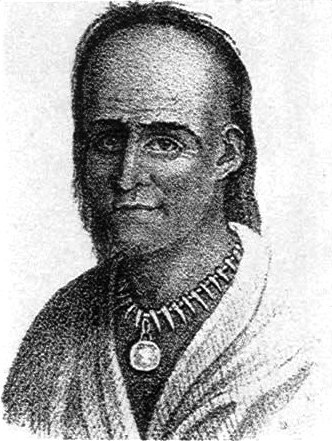
Late 18th century lithograph of Mihšihkinaahkwa reputedly based upon a lost portrait by Gilbert Stuart which was destroyed when the British burned Washington DC in 1814
A year later, in 1791, Washington once again ordered the destruction of the Miami capital, this time entrusting the duty to General Arthur St. Clair. Once again, a lack of experience and frequent desertions were an immediate problem for the Americans. The number of troops quickly whittled to nearly half its original size, from 2,000 to around 1,000 men. On November 3, 1791 they made a crucial error. St. Clair’s troops camped for the night near the mouth of the Wabash River, and failed to form any defensive positions, leaving themselves vulnerable. Chief Mihšihkinaahkwa led a group of 1,000 warriors at dawn to attack the camp, and overtook them with ease. The ensuing battle, called the Battle of Wabash, still maintains the highest casualty rate of any battle in U.S. history, with 630 of the 930 American militiamen being killed, and 264 more wounded. The Confederacy, in comparison, lost only 21 men.
The Northwestern Confederacy was eventually defeated in 1794 in the Battle of Fallen Timbers. Washington, determined to wipe them out and finally seize their land, assigned General “Mad” Anthony Wayne to do what Harmar and St. Clair could not. Chiefs Waweyapiersenwaw, Buckongahelas, Mihšihkinaahkwa, and Tarhe led 1,400 warriors into the battle. They were overwhelmed after about an hour of fighting by the renewed American forces and attempted to retreat to the British Fort Miami. Though they had previously been allies when it suited the British in the Revolution, the retreating members of the Confederacy were denied entrance into the fort by British Commander William Campbell.
A year later, in 1795, Chiefs Tarhe, Buckongahelas, Waweyapiersenwaw, and other representatives of the Wyandot, Lenape, Shawnee, Ottawa, Chippewa, Potawatomi, Miami, Eel River, Wea, Kickapoo, Piankeshaw, and Kaskaskia Nations signed the Treaty of Greenville. This treaty ceded 2/3rd of the land that would become the state of Ohio, ending right above modern-day Delaware County. Mihšihkinaahkwa was reluctant to sign, but was eventually convinced after Anthony Wayne revealed to him that the recently ratified Jay Treaty meant that supplies sent from the British in Canada would no longer be able to reach Ohio. Cut off from this support network and without any other allies, his was the final signature on the document.

A depiction of Chief Tarhe from a 1909 book on Ohio history