The German Roots of German Village
By Ronan Thompson | Research & Archives Coordinator
Through our millennia-long journey so far through German Village history, we have seen a diverse array of cultures and communities who made their mark on the area: Adena, Hopewell, Shawnee, Wyandot, French, British… But something is missing. Where are the Germans? Well, they’ve actually been here for quite a while. The first European towns and settlements in Ohio were the Moravian mission villages of Shoenbrunn and Gnaddenhutten. These German speaking protestants came from modern day Saxony to proselytize to the Native communities, but they were up along the Tusarawas River, not the Scioto. They were also technically Czech. It’s a long and complicated story, enough so that I’ve previously written a 30 page research paper on it, but suffice to say that German influence in Ohio has deep roots.
The first United States census in 1790 recorded 445 Germans living in the Northwest Territory (which included Ohio, Indiana, Illinois, Michigan, and Wisconsin), representing 4.24% of the population. These small but significant populations would explode in the following decades, and by 1865 a third of Columbus’s population was German. The obvious question is: why? What drove these people from their homes, and what was it that made them decide to settle down here of all places? One simple answer is because it was cheap. As we learned previously, John McGowan was granted over 300 acres of land, which had been forcibly seized from its Native inhabitants, and so he could turn a large profit by selling numerous tracts at low prices. Buying land in “undeveloped” areas such as Ohio was far less expensive than settling in Boston or Philadelphia.

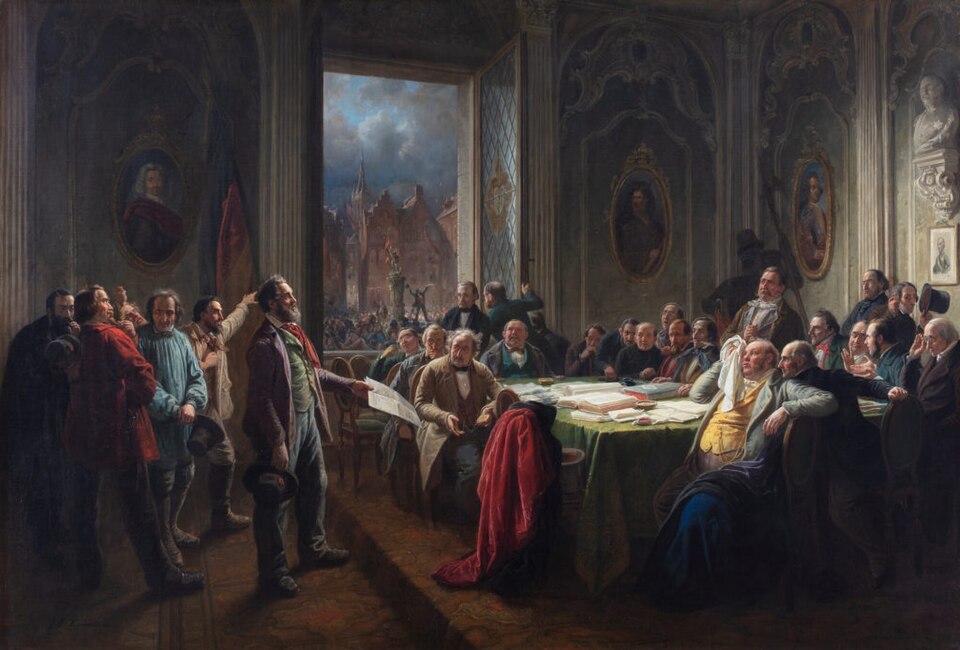
This 1850 painting by Johann Peter Hasenclever shows a delegation of revolutionary workers presenting a petition to the town council. It is based on a real delegation of 600 unemployed workers who petitioned the council for work in 1848, and is considered the first depiction of confident working class people in German painting. File:Johann Peter Hasenclever – Arbeiter vor dem Magistrat.jpg – Wikimedia Commons
The first small-scale uprisings in the German Confederation began in 1830, when textile mill workers in Altenberg began disassembling equipment with makeshift tools. This sparked other similar worker’s protests across the states, which culminated in the German Revolutions of 1848-1849. The Revolution sought to unify Germany under a liberal political system that would improve the lives of working class citizens, liberate those still living under serfdom, and shift more political power to the hands of the workers and peasants. Many states successfully overthrew their autocratic leaders and installed provincial revolutionary governments and the serfs were freed from bondage, however, the Revolution failed to unify the German States under a liberal democracy. Upper and middle class leaders were disinclined to challenge the status quo from which they benefitted and continued to work with monarchs, and internal disputes made the revolutionary parliament incapable of actually getting much done. Many monarchs ended up regaining most of their power, and the more radical working class revolutionaries were exiled. Others made the choice to leave as battles waged on and average living conditions showed little improvement.

This 1848 engraving depicts the first Frankfurt Parliament in 1848, a largely ineffectual coalition which was stymied by internal disputes between the middle and working class members. File:Zeitgenössige Lithografie der Nationalversammlung in der Paulskirche.jpg – Wikimedia Commons
“They rebuilt their lives thousands of miles from everything they had ever known, and the culture they brought with them continues to live on to this day.”
After years of back-breaking labor, political organizing, and fighting for the right to make enough money to feed their families, they were betrayed and forced out of their homes. They packed into cramped, stinking ships rife with diseases and pests and began the month-long journey to America. That long road brought many of them here. They built sturdy brick cottages, planted gardens, and opened schools, newspapers, churches, and breweries. They rebuilt their lives thousands of miles from everything they had ever known, and the culture they brought with them continues to live on to this day.

A 19th century elementary class photo from German Village. German immigrants were responsible for shaping the Columbus school system from its earliest years, and introduced some of the first kindergartens in the country. Families of German Village Collection – SC_Gvfamilies | German Village Society
This brings us to the end of our journey, at least for now. My goal with this series was to give a brief overview of the thousands of years of history that led to the establishment of German Village, and I think that has been achieved, but there are so many other paths we could have taken along the way. Perhaps in the future we will return to our time machine and continue our explorations. If there is anything you think should be covered in more depth, or that we missed entirely, feel free to let me know! Thank you all for joining me and helping to foster important conversations about the past that can help us better understand the present.