First Contact
By Ronan Thompson, GVS Research and Archives Coordinator

This painting, titled Medicine Woman, by contemporary Shawnee and Lenape artist Ruthe
Blalock Jones highlights how indigenous aesthetics and artistry have evolved into the modern
day. Blalock Jones, Ruthe. Medicine Woman. 02.1942. late 20th century. Tulsa: Gilcrease Museum, (04/10/2019)
In 1802, a Scotsman was awarded land from the U.S. government meant as payment for Canadian participation in the Revolutionary War; land which would go on to fill with German immigrants. But did you know that a century prior, the land that would become German Village was actually a part of New France? Or that Central Ohio would become the stronghold of “Indian Territory” and a center for military and cultural resistance to European colonization? For this stop on our journey through German Village history, we’ll be traveling back to the mid-1600s, when the first European settlers began encroaching into Ohio. We’ll explore the complex webs of interaction between the myriad of communities, both indigenous and European, which influenced the settlement of this area.
A Land Already HOme
We have already seen in our journeys how the Adena, Hopewell, Cole, and other cultures created massive metropolises of cultural production. When the first Europeans arrived in Central Ohio, they compared it to stumbling upon the Garden of Eden. Ohio is incredibly rich in natural resources, and the rivers and streams create natural highways to transport goods across vast distances. An estimated 95% of the land was covered in old-growth forests teaming with game; sturgeon half the size of a canoe leapt from the Scioto; indigenous women tended fields of corn that stretched for miles, and prosperous orchards of apples, peaches, plums, and cherries perfumed the air.
Nations such as the Illinois, Miami, and Shawnee had lived along the Scioto River for
centuries, and nations who were being forced out of their ancestral homelands along the East
Coast began migrating across the Appalachian Mountains and settling in Ohio. Beginning in the 17th century, people from the Lenape, Seneca, Cayuga, Mohawk, and other eastern nations flooded into Ohio and settled in multi-ethnic, multi-lingual villages. The majority of the nations living in Ohio spoke Algonquian languages, such as the Shawnee, Lenape, Illinois, and Miami. The other large language group was the Iroquoian-speaking nations, which includes the Mohawk, Seneca, and Cayuga tribes. Political and social alliances were often divided along the lines of these language families, though each nation has its own unique language and culture.
As we observe one of these villages along the Scioto, we see a mix of about 50 circular
and rectangular wooden houses. Inside the largest, central structure, a group of soldiers and
politicians sit on a thick woven mat with their heads together over a map. They draw a line down the Scioto and across the Ohio River into what is now Kentucky, where colonial militia forts keep springing up and blocking their access to annual buffalo hunting routes. Each of them has lost at least one family member–a wife, a mother, a child–in one or another brutal massacre committed by these enemy soldiers or the settlers they protect. Others they lost to disease or starvation. They are far from home, but determined to defend this new land they have been welcomed into. Outside, they hear a group of women singing as they grind corn into flour; they hear the laughter of their children playing a ball game as they wait for their maple sugar candies to harden. Further away, but not as far as they would like, they hear the rumbling of musket fire crack across the sky like thunder. It is not as easy a decision as it might seem, whether to capitulate to these invaders or to wage war against them. One has a sister married to a French blacksmith who lives in this village alongside them; several of them have recently converted to Christianity after recent meetings with the Moravian missionaries up north; they have a history with these people, they have traded and negotiated and lived with them. Despite this, the threat they pose is impossible to ignore.

Map showing European land claims in the early 18th century, prior to France’s loss in the Seven Years’ War.
The French arrive
The earliest Europeans to set foot in Ohio were French fur traders headquartered in
Detroit. Their indigenous trading partners north of the Great Lakes had told them about the
massive, wealthy, and powerful cultures who lived below them. When the French arrived in the 1650s, however, they encountered societies already negatively impacted by colonization. The same trade routes that once spread opulence and luxury materials throughout the country now brought wave after wave of devastating foreign disease from the East Coast and Southwest. Populations were decimated, with up to 90% dying after just two generations of exposure.
The French fur trade brought wealth and power to indigenous communities in Ohio, but it
also brought strife. Conflicts between indigenous nations increased as land that once provided
plenty for everyone was exploited more heavily than ever before. Trapping and hunting grounds were highly disputed, especially as refugees from eastern nations continued to move into the area. Iroquoian-speaking nations allied themselves strongly with the British, who encouraged raids on Algonquian villages to both secure trapping lands and capture slave labor. The Algonquian communities, in turn, aligned with the French, who provided protection and supplies for counter-raids. Illegal settlers were also beginning to push into Ohio, despite the land still being formally recognized as “Indian Territory.” When the Seven Years’ War broke out in 1756, Ohio became one of the most important staging grounds for the conflict between the French and the British. In the end, Louis XV was forced to cede his territory east of the Mississippi, but the fur trade had been declining in profitability for decades anyway. The French colonial presence dried up, leaving Ohio’s indigenous communities now lacking a powerful ally.
The British Take Control
British officials occupied abandoned French forts in the Ohio region and took an entirely different approach to their diplomatic relations with the Indigenous populations. More accurately, they abandoned all diplomatic relations and treated Indigenous Ohioans with open contempt; rather than respected trade partners, they became an obstacle in the way of claiming more land. British Commander in Chief of North America, Jeffery Amherst, implemented policies to restrict the amount of weapons and gunpowder Indigenous people were allowed to purchase, as well as ending the French practice of exchanging gifts with local leaders, a practice that Indigenous communities saw as a crucial sign of respect.
In response to this, many nations in Ohio and the surrounding areas began banding together in order to resist the British occupation. This confederation included people from nations such as the Odawa, Ojibwe, Potawatomi, Wyandot, Miami, Wea, Kickapoo, Mascoutens, Piankashaw, Lenape, and Seneca-Cayuga. While each nation, village, and individual had their own allegiances and goals–and not every member of every nation listed was involved–this represented a massive coalition of people coming together across linguistic and cultural barriers to unite under a common cause. This coalition organized raids against British-occupied forts beginning in 1763 in what would become known as “Pontiac’s War,” after a prominent Wyandot military leader. They successfully captured eight British forts over the spring and summer of that year. In response, violence perpetrated by militiamen and civilian settlers increased, and many villages that had no ties to the war were targeted and massacred. Jeffrey Amherst proposed the idea of using infected linens from smallpox patients to cripple the Indigenous coalition, and in June the British officials at Fort Pitt gave representatives of the Lenape tribe two blankets and a handkerchief infected with smallpox. Pennsylvania began issuing monetary rewards for every Indigenous person above the age of 10 who was killed.
The British were unable to fully suppress this coalition, and the coalition was unable to
fully remove all British presence from their lands, and the conflict ended in a stalemate in 1766. The Native coalition was successful in negotiating for better diplomatic relations modeled on their previous alliance with the French. While British officials were, for the most part, willing to put an end to a war which they did not have the resources to fight after the Seven Years’ War drained the coffers, civilian settlers did not feel the same way. Settlers wanted to expand westward into the fertile Ohio River Valley, and they had little regard for those already living there, whom the government had just recently been encouraging them to slaughter. In his book “The Indian World of George Washington,” historian Colin G. Calloway explains why the settlement of Ohio Territory was so rapid, unregulated, and violent: “Americans could not conceive that government had any right to stop them taking possession of territory that was uninhabited or occupied only by a few scattered tribes of Indians, or that they needed to respect treaty pledges made to people they considered ‘little removed from the brute of Creation.’” One of the most prominent of these illegal settlers was a young George Washington, serving as a surveyor and head engineer of frontier fort construction. Washington would continue to serve a key role in strategically eviscerating Native resistance and life in Ohio until its complete annexation by the United States, something we will explore more in the next stop on our journey.
In 1768, the Treaty of Fort Stanwix was signed between British Officials and the Iroquois
Confederacy, opening up land south of the Ohio River (in modern day Kentucky and West
Virginia) to settlement. The Iroquois Confederacy, longtime allies of the British, had gained
claim to this land during the previous decades’ Beaver Wars when they fought with Algonquian nations to gain control of hunting and trapping land. The Shawnee Nation, however, had ancient ties to that land, and did not recognize Iroquois authority to sign it over to colonial control. This loss of land, along with the continued rise in violence against Native villages–such as the Yellow Creek Massacre of 1774 in which famous Cayuga orator James Logan’s wife, brother, sister, niece, and nephew were all killed–forced the Shawnee and their allies to continue the fight. Logan had long been an ally of Europeans, but joined the resistance after the tragic loss of his family. His famous speech, known as Logan’s Lament, was published in 1775 and stirred the hearts of settlers who disagreed with the brutality perpetuated by their peers. It remains a chilling look into the magnitude of loss inflicted on Ohio’s indigenous peoples. The most famous lines read:
" I appeal to any white man to say, if ever he entered Logan's cabin hungry, and he gave him not meat; if ever he came cold and naked, and he clothed him not. During the course of the last long and bloody war, Logan remained idle in his cabin, an advocate for peace…[but] last spring, in cold blood, and unprovoked, murdered all the relations of Logan, not sparing even my women and children. There runs not a drop of my blood in the veins of any living creature… Who is there to mourn for Logan? Not one.”
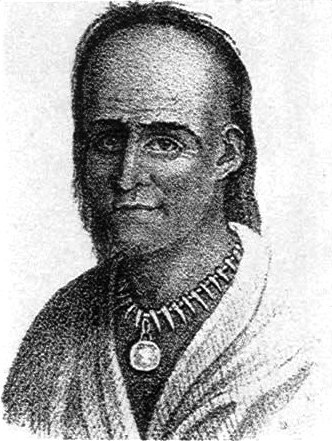
Tah-Gah-Jute, also known as James Logan

An 1873 depiction of Chief Logan discovering his slain family after the Yellow Creek Massacre of 1774.
This history may seem distant, but each piece fits together to build the picture of what
Central Ohio is today. One of the things I love most about studying the past is seeing the ways in which things that seem so far removed from my own life have actually shaped the person I am. German Village would not exist if 17th-century French nobles didn’t have a taste for beaver-lined cloaks. That’s an oversimplification, of course, but it does help to put things into perspective. This was far from a comprehensive look at the early settlement of Ohio, but an overview of some of the events that made German Village possible today. The history of colonization and forced removal in Ohio can feel difficult to talk about for a myriad of reasons, but it is essential to foster safe spaces to discuss the difficult parts of our history. I will also reiterate that Ohio’s indigenous communities did not disappear, and these cultures continue to thrive here and across the nation. If you’re interested in learning more about Shawnee history in Ohio, I would recommend a day trip to Great Council State Park in Xenia, Ohio. The Visitor’s Center museum was curated in collaboration with the three federally recognized Shawnee tribes (now based in Oklahoma), and the short hike through restored wildflower prairie is stunning. If you’d like to read about the fur trade and Native agriculture in more detail, I recommend Susan Sleeper-Smith’s “Indigenous Prosperity and American Conquest: Indian Women of the Ohio River Valley, 1690-1792.”
Next time, we will jump back in at the start of the Revolutionary War and trace the battles
and treaties which led to John McGowan’s land grant. I appreciate your patience with this
longer-than-usual stop on our history journey. If you have any questions or would like more
reading recommendations or resources, always feel free to reach out to me. As a reward for
reading all the way to the end, I’ll let it slip that I’m in the process of organizing a “German
Village History Club” to host monthly wine and history nights featuring short lectures from local historians. If you’ve enjoyed our journey so far, this will be the perfect opportunity to continue exploring.

A modern powwow dancer in a jingle dress. The metal bells were introduced by French traders in the 16th century and have been thoroughly incorporated into traditional regalia. The jingle dress originated with the Ojibwe, but is now common throughout Great Lakes nations and is associated with healing dances. This image is in the public domain.